


About 100 residents from Hualien County’s Sioulin Township (秀林) rallied outside Taiwan Power Co’s (Taipower) headquarters in Taipei yesterday, accusing it of secretly preparing to build a nuclear storage facility near the township, and calling on the company to apologize and to put a stop to the project.
“We are here to formally ask Taipower’s chairman and chief executive to come to Sioulin within a week to deliver their apologies and to promise that the project will be permanently halted,” Sioulin Mayor Hsu Shu-yin (許淑銀) said.
“If Taipower fails to do so within a week, we will seal up the facility by ourselves and we will not renew Taipower’s lease on the land on which its electricity pylons stand,” he said.
Hsu and other Sioulin residents are upset because Taipower was discovered to be drilling a 200m well in in the township’s Heping Village (和平), which the locals suspect to be preparatory work for a nuclear waste storage facility.
“There are several power plants in Sioulin and more than 100 pylons to transmit the electricity, yet Hualien and Taitung counties combined use less than 5 percent of electricity used in the nation,” Hsu said. “We’ve sacrificed so much to provide electricity for the entire country while using so little of it, it’s not fair if the Taipower tries to dump nuclear waste on us as well.”
Having learned about the well only after Democratic Progressive Party Legislator Hsiao Bi-khim (蕭美琴) exposed the project, Hsu said that neither the township office nor the county government were informed of what Taipower was doing in Sioulin.
Hualien County Environmental Protection Bureau Director Lai Hung-ming (賴鴻銘) also attended the rally to express the county government’s opposition to any plan to dump nuclear waste in the county.
“It’s a shame that Taipower is doing something in Hualien without informing either the county government or the township office,” Lai said. “Taipower should apologize to all the 340,000 residents of Hualien and seal up the well right away.”
Masa Rikaw, a resident of Heping Village, said it took her eight hours to travel to Taipei to protest.
“I came here because if nuclear waste is dumped in our village, it would threaten the health and lives of not only us, but also our children, grandchildren and the generations to come,” she said.
Angry protesters tried to throw eggs at the Taipower building, but most were confiscated by police before they could be thrown.
Lawmakers across party lines, including Hsiao, Non-Partisan Solidarity Union Legislator May Chin (高金素梅), who is half-Atayal, and Chinese Nationalist Party (KMT) Legislator Sra Kacaw of the Amis tribe, took part in the demonstration to show their support for the residents of Sioulin.
All three lawmakers said Taipower was in violation of the Aboriginal Basic Act (原住民族基本法), which stipulates that local Aborigines must consent before any activities initiated by outsiders in traditional Aboriginal lands take place.
In response, Taipower spokesman Roger Lee (李鴻洲) said yesterday that the company would apologize for not having communicated well with the local residents before drilling the well, but he stressed that the well was for geological research and it had nothing to do with building a nuclear waste storage facility.
He also promised that Taipower would permanently terminate the project in Sioulin and that it would seal up the well within a week.


UPGRADE: The Kang Ding-class frigate is replacing its Chaparall missiles with Tien Chien II and Hua Yang VLS, which would provide it with long-range, 360° air defense Taiwan plans to produce 1,200 to 1,376 Hai Chien II missiles (海劍二, Sea Sword II) — also known as TC-2N — to serve as the standard air defense system of the navy’s surface combatant fleet, a source said yesterday. Last week, the Hai Chien II, the naval version of the Tien Kung II missile (天劍二, Sky Sword II), completed a live-fire test in waters off the National Chungshan Institute of Science and Technology’s Jiupeng facility (九鵬) in Pingtung County’s Manjhou Township (滿州). The MIM72 Chaparral and other dated air defense missiles that currently arm Taiwanese ships have inadequate range to combat Chinese

REASONS FOR TRAVEL: An assistant professor said that proposed amendments to penalize drivers if they used drugs overseas would not deter people from traveling People who operate a motor vehicle under the influence of marijuana would have their driver’s license revoked, even if they used the substance while overseas, the Ministry of Transportation and Communications said yesterday, citing proposed amendments to the Road Traffic Management and Penalty Act (道路交通管理處罰條例). The amendments would also authorize the government to revoke the licenses of people determined to have used Category 1 or Category 2 narcotics, even if they were not operating a vehicle while under the influence of drugs, as well as ban them from taking the license test for three years, the ministry said. People aged 18 or
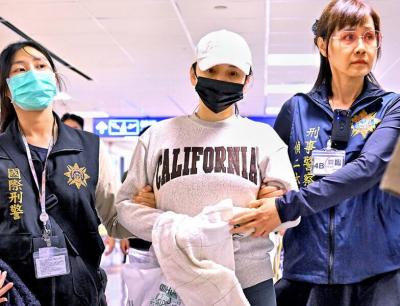
Johanne Liou (劉喬安), a Taiwanese woman who shot to unwanted fame during the Sunflower movement protests in 2014, returned to Taiwan last night after being deported from the US. She is to stand trial in Taiwan for charges involving embezzlement, fraud and drug crimes. The Criminal Investigation Bureau (CIB) said it took her into custody at Taiwan Taoyuan International Airport and would first question her before transferring her to the New Taipei District Prosecutors’ Office. She was arrested upon disembarking a flight from San Francisco that landed shortly before 7pm. Liou absconded to the US in 2019 after jumping bail
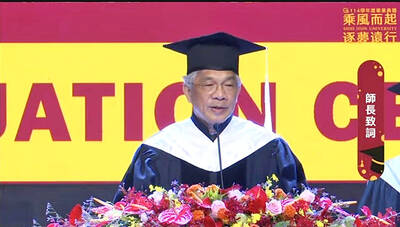
Shih Hsin University President Chen Ching-he (陳清河) yesterday issued a public apology for comments made in his commencement speech last week, stating that he has asked the school to suspend his duties and halt his wages for two months as a show of contrition. At the commencement ceremony on May 30, Chen said, “If you don’t manage your time well, or your own emotions, or your health, then I am telling every one of you — put a quick end to ‘you,’ because the world has no need for ‘you.’” The comments have sparked significant controversy online, and Chen through an open


 RSS
RSS